
The Reality of Gridlock


Overview:
In early July, we wrote about November's midterm elections and how the results may impact your portfolio and financial plan. This political cycle may shape policy in Washington more than usual. The outcome could determine how much President Trump can accomplish in his final two years, with ripple effects spanning the federal deficit, geopolitics, energy, housing, and technology.
With less than a month until midterms, the campaign noise is intensifying. Democrats appear likely to flip the House of Representatives, and the Senate races are increasingly competitive. The most likely outcome is some form of gridlock, which has historically been good for risk assets. Equity and fixed income markets are still watching closely, though, pricing in the policy implications as the picture comes into focus. At Diversify, our job is not to predict the election outcome; it’s to construct durable portfolios to help you meet your financial goals.
Diversify’s Take:
Current Race Picture
In the House, the party that holds the White House typically loses seats in midterm elections. The President's party has lost House seats in 20 of the last 23 midterms, with a median loss of 26 seats. We view this as largely a psychological shift driven by voters reverting to the mean. The three exceptions came during unique moments in time: 1934 was during the depths of the Great Depression; in 1998, the push to impeach Clinton backfired on GOP opponents; in 2002, the country was still rallying around Bush following 9/11. Today, with low Presidential approval ratings and Democrats needing to flip just three House seats, we expect the historical pattern to repeat.
Democrats face a steeper climb in the Senate, where they need a net gain of four seats and several battlegrounds lean Republican. Despite that, prediction markets have recently shifted in Democrats’ favor as races in Texas, Alaska, Ohio, and North Carolina have tightened. Below are the prediction markets' implied odds for control of each chamber, in addition to the polling data from the nonpartisan Decision Desk HQ (DDHQ).¹
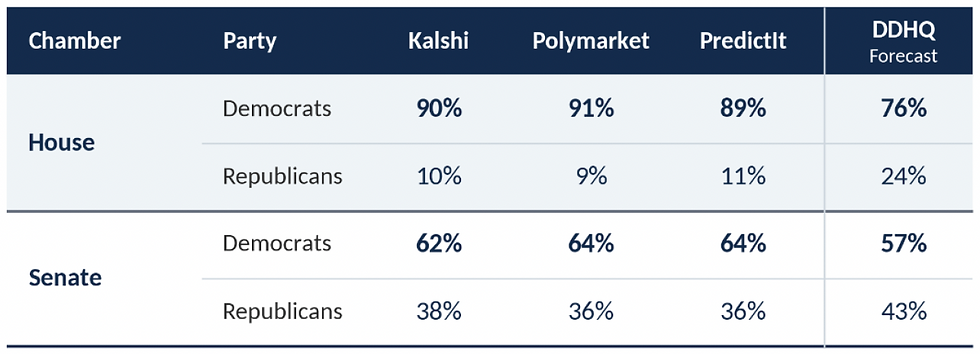
While the polling data are directionally aligned with that of the prediction markets, they point to tighter races. In other words, traders are more confident than the polls are reflecting. We'd also caution that midterms are rarely as settled one month out as they appear, and individual races and voter preferences can shift quickly.
The Reality of Gridlock
The last two years of one-party control have allowed the administration to move fast. Taxes, energy policy, immigration enforcement, and deregulation all advanced at a pace divided government rarely allows. We suspect that era is coming to an end. But a split Congress won't stop Washington outright. It would mainly slow down new legislation like tax changes, spending bills, and anything that needs bipartisan support to pass. Trade policy, foreign affairs, and most federal regulation largely remain under White House control.
What would likely change is the degree of oversight. A Republican Senate paired with a Democratic House likely means limited legislative bandwidth and more scrutiny of the administration. A Democratic sweep of both chambers would mean more aggressive oversight and tougher fights over regulatory policy. In both scenarios, new legislation would likely slow to a crawl, which is the definition of gridlock.
A Democratic win in either chamber also means more funding fights. Divided government has historically made new spending harder to pass, and with a $40 trillion debt burden and large fiscal deficit, we don't see much appetite for new spending packages regardless of who holds power. That fiscal strain has already been a factor in this year's bond market selloff, much to Treasury Secretary Bessent’s chagrin. The debt ceiling is the first real checkpoint to watch. Though this has unfortunately become a regular occurrence, our base case is a combative standoff that tips into a government shutdown in early 2027.
Hot Button Items
Following are several issues we’re watching closely that are directly tied to voter sentiment and economic fundamentals.
The cost of living: part of the Trump administration’s campaign was built around affordability, yet inflation is running 3-4%, and disinflation won’t be arriving anytime soon. The war with Iran, which appeared to be cooling over the summer, remains in stalemate. There is a reasonable case that Tehran will hold off on negotiations until after the midterms to pressure the GOP. Gasoline is back near its spring highs, and diesel, which is used to transport most goods, is hitting all-time highs. For many income cohorts, higher energy prices are starting to crimp discretionary spending. High prices at the pump are a tangible, recurring issue that voters actually feel. The President has proposed a $5,000 payment to every American if Republicans hold both chambers. That kind of fiscal injection would likely nudge inflation higher.
The cost of capital: the Federal Reserve (Fed) raised interest rates in September for the first time in three years, and the intermediate and long end of the Treasury yield curve is hitting 25-year highs. Related to spiking yields, housing costs are receiving a lot of attention. As of this writing, the average 30-year fixed mortgage rate is hitting a cycle-high 7.4%, slowing housing activity and pressuring consumer confidence. The President is introducing new housing initiatives aimed at lowering costs for home buyers.
AI and data centers: technology has become a genuine campaign issue. Over the past several months, local opposition to new data center construction has grown, along with Washington and leading tech executives calling for tighter AI oversight. Some states and municipalities are now discussing or implementing limits on new data center sites. Tied to that is how our nation can balance traditional energy production with the surging power demands from data centers. Though the AI buildout is driving a large percentage of economic growth and corporate earnings, Americans have become increasingly skeptical of it. This likely isn't a shift in federal policy as much as a broadening in local opposition, and that's what could realistically slow progress. If there is a slowdown in new data center approvals, heavier regulation of the companies building them, or heightened scrutiny on the speed with which AI is moving, the equity market will recalibrate earnings growth assumptions.
Investment Implications:
Fixed Income
Though not directly linked to the midterms, we’re witnessing one of the largest moves in bond yields we’ve seen in decades. The 10-year Treasury yield now stands at 5.25%, the highest level in a quarter century.² The swift upward yield pressure is due to high inflation, durable economic growth, and investors needing to be compensated for enormous bond supply growth spanning the public and private sectors to fund our fiscal deficit and the AI buildout, respectively. This technological boom has capital demands unlike anything we’ve seen, and the large players are increasingly tapping the investment grade markets to fund it.
On the front end of the curve, we see little chance of an October hike on the heels of September’s move, particularly the week before midterms. But a 25bps hike in the December meeting looks probable (~70% odds according to the CME FedWatch tool), including the potential for more tightening in 2027.³
High oil prices and a labor market that isn’t rolling over make a quick return to lower inflation unlikely, in our view. We continue to expect a “higher for longer” rate environment, reinforcing the compelling levels of inflation-adjusted yields we can secure from high-quality bonds (~3.0% real). We continue to favor strong issuers and short to intermediate maturities. That lets clients earn today's yields without taking on unnecessary risk if long-term yields rise further on concerns about deficits, a government shutdown, inflation, or bond supply. We maintain a strong preference for owning high-quality individual bonds directly rather than commingled funds. If rate volatility remains high and credit spreads wobble, having a defined maturity schedule and known cash flows is a structural advantage.
Equity
Equity volatility typically intensifies leading up to November due to rising uncertainty around policy initiatives including taxes, spending, and regulation. This year has been different. The S&P 500 is up ~12% YTD, while the average midterm year has been roughly flat at this point in the calendar.
Once the election fog clears, the market historically takes an optimistic view and shifts its attention back to fundamental drivers. As the Fidelity chart below shows, year three of a president’s term has historically been the highest performing stretch of the political cycle for equities.⁴ Going back to 1950, the 12 months following midterms has produced an annual average return of +14.5%. Strategas research reveals that in the post-war era, the S&P 500 has never declined in the 12 months following midterm elections.⁵

Given the likelihood of a return to a balance of power in Washington, Morgan Stanley research shows that under a Republican president, the strongest average S&P 500 returns (+23%) in the 12 months following midterms have historically been when Congress is split. Part of those large gains is linked to the gridlock scenario described above. When sweeping reform is less likely, the range of potential policy outcomes narrows and there is less market uncertainty.
Corporate earnings have been strong enough to overwhelm a tenuous geopolitical backdrop. With Q3 earnings season kicking off this week, earnings are expected to grow 30% year-over-year. If realized, that would be the third consecutive quarter of 25%+ earnings growth. The AI capex supercycle is doing a lot of the heavy lifting, in addition to margin expansion. The S&P 500’s operating margin is hitting a record high of ~17%. Our view is the tech-fueled productivity cycle is still in early innings.
The AI buildout will likely continue to be the primary driver of this market, but it is masking a lot of weakness under the hood in most sectors and industries. J.P. Morgan research shows that 60% of S&P 500 stocks are down at least 20% from their all-time highs, despite the market being near all-time highs.⁶ The concentration and top-heaviness are at extreme levels. Earnings strength is also overpowering the typical gravitational weight of higher interest rates on long-duration assets like equities. There are political risks that could slow the AI buildout as outlined above, but inertia is a powerful force when it is propping up this much of the market and economy. We continue to favor long-term ownership of high-quality businesses with the pricing power and balance sheets to handle whatever comes their way.
Alternative Investments
Strategies built on contractual income, rents that reflect our nation’s housing shortage, operational improvement of private companies, or ownership of real assets can be a ballast for portfolios through this inflationary regime. Infrastructure and energy-related real assets often generate revenue that moves with prices, and private credit that pays a floating rate adjusts upward as the Fed tightens. Structured notes also benefit from higher rates, and their terms typically improve with volatility.
The offset is that higher interest rates weigh on the valuations of existing real estate investments, and ongoing starts and stops to the IPO calendar could continue to push out realized returns for existing private equity investments.
For clients with the appropriate time horizon and illiquidity tolerance, we continue to see benefits in portfolio allocations to alternatives as important diversifiers to stocks and bonds.
Summary:
The most likely result next month is a divided Washington. That would curb legislative activity and reinforce the status quo across much of the political landscape. Historically, a gridlock outcome has been good for stocks once the election is behind us.
Our focus remains on sound portfolio construction and true diversification. That increasingly matters as fiscal risks mount and the horizon grows less certain. As always, if you'd like to talk through what this means for your own portfolio, reach out to your Advisor. Thank you for your trust and confidence.
David Wrigley
Chief Investment Officer
Source: Kalshi, Polymarket, PredictIt, Decision Desk HQ, Diversify Asset Management, as of October 8, 2026
Source: FRED, as of October 8, 2026
Source: CME Group, as of October 8, 2026
Source: Fidelity Investments, as of August 12, 2026
Source: Strategas, as of September 30, 2026
Source: J.P. Morgan Asset Management, as of September 26, 2026
The information contained herein is the opinion of the author as of the date the market update was written and is subject to change without notice as markets change, and new information is available. While Diversify utilizes sources deemed to be reliable, we have not independently verified the content. Investors should carefully consider any changes based on this market commentary and discuss their individual circumstances with their trusted advisors. Past performance is not indicative of future results. This communication is for informational purposes only and should not be construed as investment advice or a recommendation.


